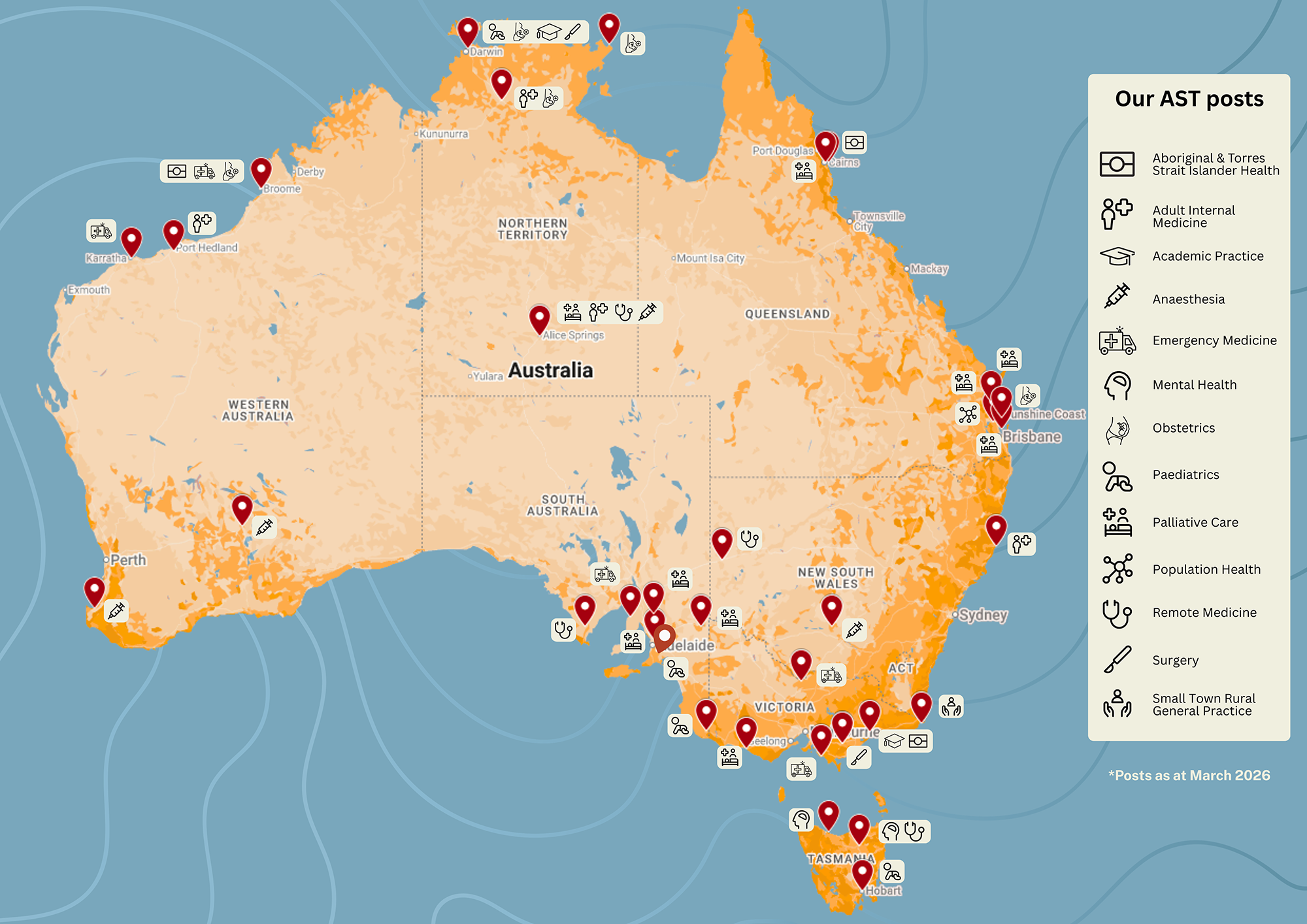
The new Advanced Skills Training Posts Rural Generalists and General Practitioners Program (AST Program) is an initiative of the Australian Government administered by the ACRRM to support 15 AST training posts per annum for the 2024, 2025 and 2026 training years.
The intent of the AST Program is to identify innovative training opportunities that develop the skills required by our rural communities and provide participants with a positive, high-quality training experience.
Further information on eligibility, how to nominate and how to apply to the program can be found in the Advanced Skills Training Posts Rural Generalists and General Practitioners Program (AST Program) Operational Procedures, the AST Program Guidelines, Department of Health and Aged Care website or contact us on astprogram@acrrm.org.au.
The AST Program supports high quality 12-month AST posts in hospital, general practice community and non-general practice community settings. The program will contribute toward the costs of an AST post for ACRRM and RACGP Registrars and Fellows in regional, rural and remote Australia to attain advanced skills.
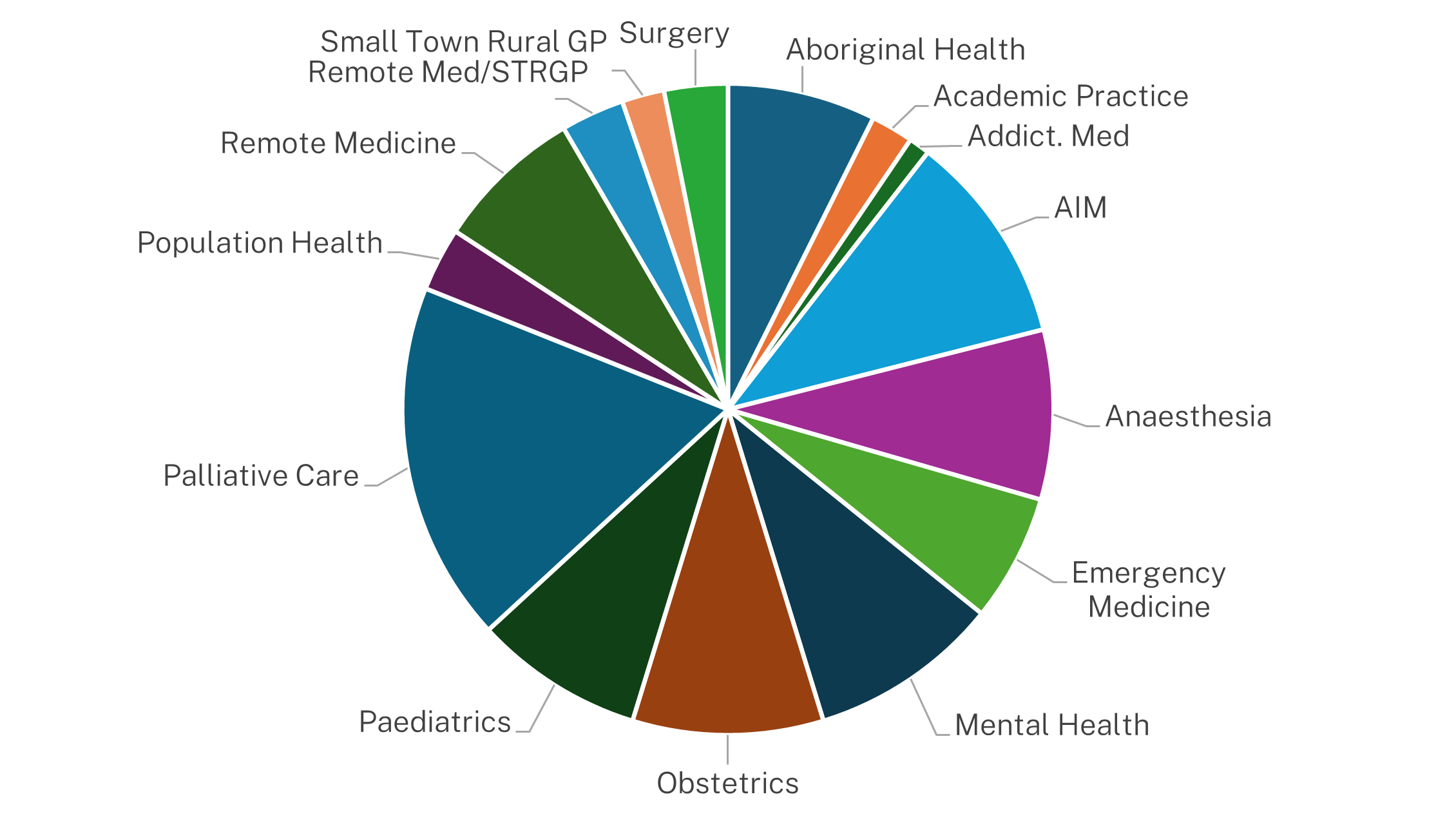
Training posts under the program will include all AST and ARST disciplines supported under the GP College curriculums. This includes non-procedural areas such as Aboriginal and Torres Strait Islander Health, mental health, palliative care, remote medicine and adult internal medicine.
You can access the full list of ACRRM AST disciplines here and RACGP ARST disciplines here.
The program will fund up to $150,000 for each 12 month AST post (pro-rata where not completed) towards the cost of participant employment and training for two AST posts in each state and three in the Northern Territory for:
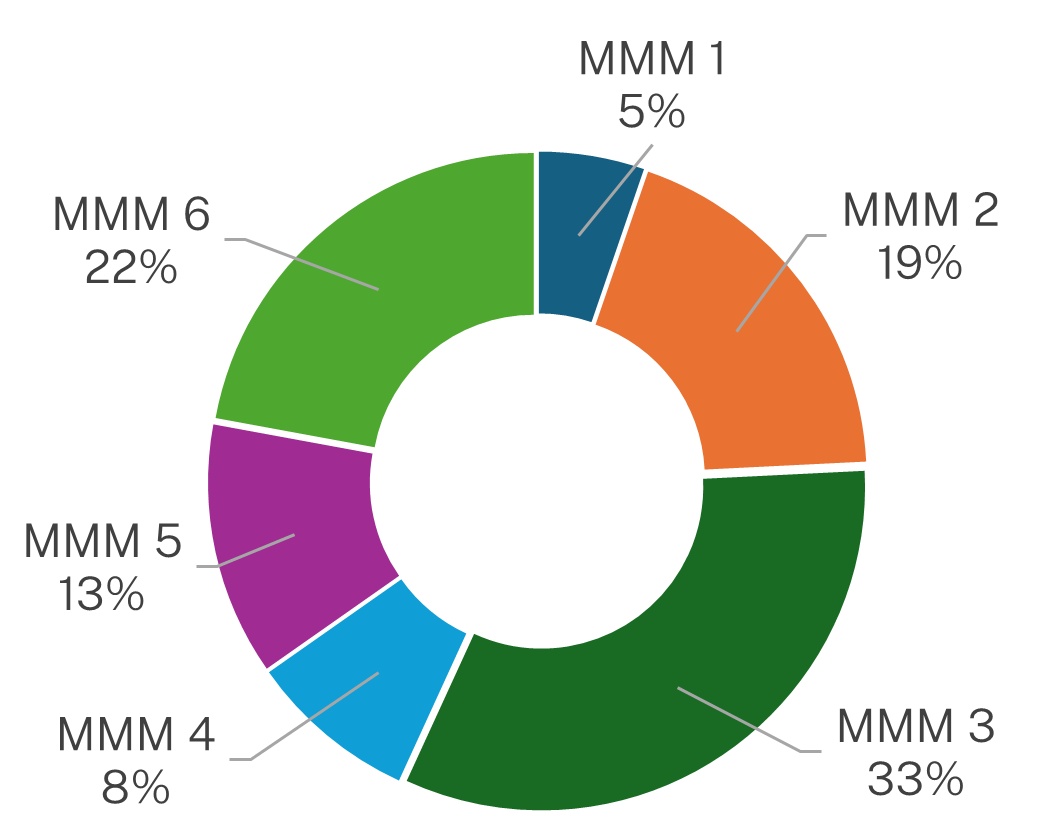
Training posts will be in Modified Monash Model (MMM) 2 - 7 locations. Consideration can be given to support MMM 1 locations if training is not available in a rural location and support for the post will fill a service delivery gap in a rural community.
You can find information on this program at Advanced Skills Training Posts Rural Generalists and General Practitioners Program (AST Program) | Australian Government Department of Health and Aged Care and the in the AST Program guidelines.
Training Posts:
To be eligible, participants must be either:
For an AST Post to be funded by the AST Program:
AST Program-funded posts can be advertised in various ways. Applications for placement into an AST program post should be undertaken in line with the advertised position:
Yes. Part-time training can be supported if all parties agree. Part-time training must comply with your College policies.
Only RG or GP registrars or Fellowed RGs or GPs are eligible to train on the AST Program.
To apply to undertake an AST approved by a GP College you must be an RG or GP registrar enrolled in a GP College training pathway or be a Fellowed RG or GP.
You are eligible to access an AST position funded by the AST Program if you meet one of the below criteria:
Remember, your GP training college must confirm you are eligible to undertake the identified AST.
No. Surgery AST may require a minimum of two (2) years to complete and will count as two (2) posts for the purpose of funding and post allocation. Training in other AST disciplines for >12 months may be considered on a case-by-case basis.
All AST disciplines supported by ACRRM and RACGP curriculums are eligible for funding. This includes non-procedural areas such as Aboriginal and Torres Strait Islander Health, mental health, palliative care, and paediatrics as well as procedural areas such as obstetrics, anaesthetics, surgery, and emergency care.
You apply for a hospital-based AST program training post via the relevant state or territory Rural Generalist Coordination Unit (RGCU) and host employer recruitment process. Note, the application process may be different in each state/territory.
For non-hospital-based posts you will liaise directly with the identified host employer of the approved AST program post and relevant College.
Posts that include a combination of hospital and community-based training settings will identify the host employer responsible for employment.
You will need to advise:
It is the responsibility of the host employer, your College and RGCU (where applicable) to notify the AST Program of your withdrawal.
Yes, an AST post can be in a hospital, general practice community and/or non-general practice community training setting. The post can be with a single organisation or comprise of a range of health settings across a number of organisations. For example, an AST post could consist of a term in a general practice and a term in an Aboriginal Medical Services (AMS).
To be eligible for funding, the AST Post must be accredited by at least one of the GP Colleges, supported by the relevant state/territory Rural Generalist Coordination Unit (RGCU) and meet the AST Program funding eligibility criteria.
All AST disciplines supported by ACRRM and RACGP curriculums are eligible for funding. This includes non-procedural areas such as Aboriginal and Torres Strait Islander Health, mental health, palliative care, and paediatrics as well as procedural areas such as obstetrics, anaesthetics, surgery and emergency care.
A post is considered new if it:
A new post is not:
The AST Program supports innovative and flexible approaches to training. If you are uncertain your training post meets the requirement for a ‘new’ training post, we encourage you to contact the AST Program team at astprogram@acrrm.org.au.
Once you have identified a potential new post these are the next steps:
If your post is in a general practice, a non-general practice community setting or a private hospital:
If your post is in a public hospital or health service:
You nominate your AST post through one or all of the following:
An AST post must have the support of the Rural Generalist Program Coordination Unit for your state or territory to be nominated.
Each state is funded for two (2) FTE AST posts per year and the Northern Territory is funded for three (3) per year.
The RGCU’s, ACRRM and RACCGP will each nominate AST posts and collectively prioritise nominations for the respective state/territory in line with the AST Program guidelines. The list of prioritised posts is then submitted to the AST Program Selection Committee who select the posts and forward to DoHAC for approval.
Yes, you can nominate an AST post that isn’t accredited however, the training post must be accredited with either or both ACRRM and RACGP before the trainee commences and the issue of funding.
We recommend AST posts are accredited at the time of nomination and where the training post isn’t accredited a plan demonstrating eligibility to meet accreditation and timeframes to submit applications is submitted with the post nomination.
No. Surgery AST may require a minimum of two (2) years to complete and will count as two (2) posts for the purpose of funding and post allocation. Training in other AST disciplines for >12 months may be considered on a case-by-case basis.
AST Program funding can be used in flexible and innovative ways to support trainees and training posts to undertake AST in rural locations. Some of the ways the funding can be used are to:
AST Program funding cannot be used for:
Training posts are to be in regional, rural and remote (MMM 2 - 7) locations. However, the AST Program may consider support for an AST post in an MMM 1 location to provide training where training is not available in a rural location and where support for the post will fill a service delivery gap in an identified community.
This also applies to training posts that include a rotation from regional, rural and remote locations in an MMM 1 location.
Up to $150,000 is provided per 1 FTE per annum. You can also apply for partial funding if you do not need or are not eligible to receive the maximum amount. Funding can be used flexibly to support advanced skills training in rural locations.
A breakdown of how you intend to use the funding is submitted when you nominate the AST post.
Public hospitals, general practices, non-general practice community health organisations, Aboriginal Medical Services (AMS), Aboriginal Community Controlled Health Services (ACCHS), Aged Care Services, Local Health Networks, private hospitals providing public hospital services, private health care organisations/settings.
If you are a registrar or Fellowed RG/GP who has identified an AST post for funding you will need to liaise with your College, either directly or via the specific health care facility, or the National Rural Generalist Program Coordination Unit in regard to nomination. Individual registrars or Fellowed RGs/GPs are not eligible to apply directly for funding under this program.
Any post funded by another organisation within the last 12 months will need to conclusively demonstrate the funding for the post is not ongoing.
No. The AST Program encourages you to look at innovative and flexible ways the funding can be used to support AST trainees and training posts to train in rural locations. For example, a trainee may need to move to another location to complete all or part of their AST training. Funds can be allocated to support the trainee with accommodation expenses.
Some ways the AST Program funding can be used are to:
An AST Post is not able to be paid for the same service twice. So, a post that is fully funded by the Commonwealth, applicant organisation or a state/ territory government will not be eligible to receive AST Program funds.
However, if an AST Post receives funds to support trainee salaries and wages only the post may be eligible to receive partial funding to support other non-funded aspects of training such as the supervisor and/or access to additional training.
Advanced Skills Training, which spans hospital and community settings where the hospital or health service is the employer, will be considered on a case-by-case basis.
You will be required to pay any funds paid in advance back to the AST Program. The AST Program team will contact you to advise if there are any funds to be returned.