Across Australia, our Rural Generalists are making a meaningful impact in their communities, shaping stronger healthcare systems, and forging diverse and inspiring career paths. Many ACRRM members have also been recognised nationally, receiving awards for their leadership, dedication, and contribution to rural and remote medicine.
Explore our collection of member stories to discover the real experiences behind rural generalism - the challenges, the rewards, and the journeys that define our College.
If you’re an ACRRM Rural Generalist and would like to share your story, we’d love to hear from you. Contact us at communications@acrrm.org.au.
You are currently on:

What she didn’t expect was to experience the town’s worst flooding in nearly three decades – followed by ex-tropical cyclone Narelle!
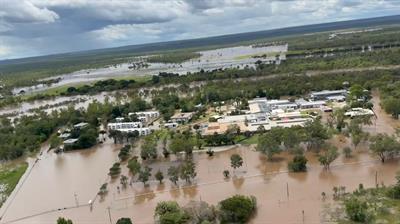
After days of torrential rain across northern Australia, the Katherine River surged to around 19.2 metres in early March — the highest level since the devastating 1998 flood — inundating homes, cutting roads and forcing evacuations across the region.
For Jacinta and her colleagues at Katherine District Hospital, it meant adapting quickly to an unfolding emergency.
“It was a bit of a stressful time,” Jacinta admits.
“A lot of the hospital staff live in the same unit complex and we were suddenly without power.
“Access was limited because drains and streets were blocked, so we were basically housebound for a few days before eventually relocating to a hotel.”
Across the NT communities have faced widespread disruption, with thousands impacted and evacuation centres opened as the flooding isolated towns and closed key roads.
The hospital itself was forced to move quickly to evacuate patients as floodwaters threatened infrastructure.
“We had to evacuate about 20 to 30 patients — essentially a full hospital,” Jacinta says.
“People who were well enough were discharged home or to family care, and others were transported to Darwin. “That included pregnant women who were 37 weeks or more.”
With the hospital building temporarily unusable, the team established a makeshift emergency department at the St John Ambulance Station, bringing what equipment they could.
While it seemed things were calming down, ex tropical cyclone Narelle crossed the NT just north of Katherine and the community had to again prepare for imminent re-flooding of the town.
Jacinta explains: “The hospital was evacuated for the second time with the support of the National Critical Care and Trauma Response Centre through the deployment of an AUSMAT hospital, which is the first time it has been deployed to this level in Australia.
“Definitely an experience!”
The response highlighted the flexibility and capability of Rural Generalist teams working in remote communities.
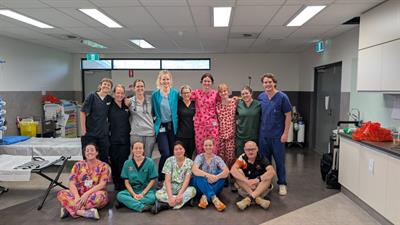
“There are up to eight registrars in Katherine over any given time and several Fellows, other healthcare workers, and a strong locum service,” Jacinta says.
“That meant we had people available to help keep services running when things got difficult.”
For Jacinta, the natural disasters also disrupted an important personal milestone. She had been scheduled to sit mock StAMPS exams during the chaos.
“I had to withdraw at the last minute because I needed to move my car from the flood zone and deal with everything that was happening with the flooding,” she says.
Despite the challenges, the experience has reinforced why she chose rural generalism.
Jacinta is now in her final year of training and has spent the past 12 months in Katherine as part of her return of service while completing advanced specialised training in anaesthetics. Her training journey has taken her across Australia — from country Victoria where she grew up, to Adelaide, rural South Australia, Port Lincoln, Port Augusta, Broome, Darwin and a stint with the Royal Flying Doctor Service.
“The variety of work is what makes this job so interesting,” she says.
In a disaster situation, that breadth of experience becomes invaluable.
“We’ve been lucky to have some very senior doctors here who have worked in really interesting places, including GP obstetricians who have worked in under-resourced areas like the Solomon Islands,” she says.
“In those environments you rely heavily on your clinical capability. “Rural Generalists are adaptable and flexible — you learn to work with what you have.”
Just as powerful as the medical response, however, has been the community spirit Jacinta has witnessed.
“I’d heard before that Katherine is a wonderful community, and this experience has really shown me just how wonderful it is,” she says.
At one point Jacinta joined local police on welfare checks, visiting residents who had been cut off by floodwaters.
“The community spirit was really strong,” she says.
“You see it in the little things — like the local coffee shop donating coffee to emergency services, healthcare workers and volunteers. It makes you feel valued.”
Even as the immediate emergency begins to stabilise, the uncertainty isn’t over. More rain has been forecast for the region, with the community preparing for the recovery phase.
Through it all, Jacinta says the experience has reinforced the unique role Rural Generalists play in supporting remote communities.
“These kinds of situations really highlight how important flexibility and teamwork are,” she says.
“And it reminds you that rural medicine isn’t just about clinical work — it’s about being part of the community and showing up when people need you most.”