

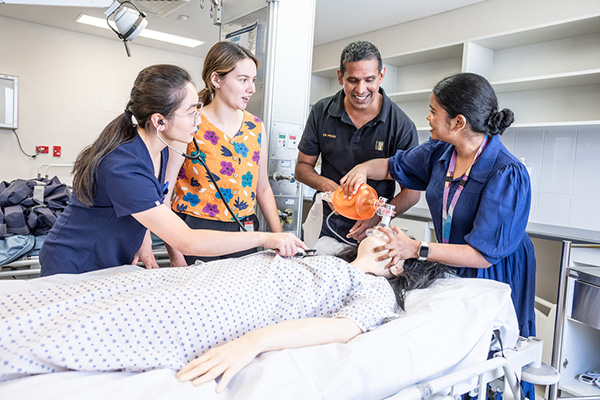
ACRRM Fellowship assessment isn't a single ACRRM exam at the end of training. It's a series of workplace-based and standardised assessments that sit alongside your placements, and each one has its own eligibility point, format and preparation pathway. Knowing the sequence early makes it easier to plan rotations, collect cases and time your exam enrolments.
This guide sets out what the training program involves, how each assessment works and what you need in place before you can enrol.
How ACRRM Fellowship training is structured
Rural Generalist training with ACRRM leads to Fellowship, and to achieve it you must complete three years of Core Generalist Training (CGT) in an MMM2-7 location, 12 months of Advanced Specialised Training (AST) (two years for surgery), the ACRRM Fellowship Education Program (AFEP), and two emergency medicine courses.
Within CGT, the requirement includes 12 months in a primary care setting, three months in emergency care, three months in secondary care, and 12 months of rural and remote practice in areas classified as MMM 4-7. You'll also need clinical experience and demonstrated skills in areas such as anaesthetics, paediatrics and obstetrics.
The education program runs in parallel with clinical training. It consists of a primary care orientation, online modules, face-to-face and virtual workshops, and cultural education delivered with Joint Colleges Training Services (JCTS). The two required emergency medicine courses are Rural Emergency Skills Training (REST) and Advanced Life Support 2 (ALS2).
How assessment works across your training
ACRRM uses what it calls a programmatic approach. The College combines workplace-based and standardised assessments with different psychometric properties, balancing, for example, the highly structured Structured Assessment using Multiple Patient Scenarios (StAMPS) against the Case Based Discussion (CBD), which assesses your practice in your own clinical environment. You need to reach at least a pass standard in each summative modality, and the combination is designed so every competency in the Rural Generalist Curriculum is assessed at least once.
During CGT, the requirements break down into two groups. You must complete six-monthly supervisor reports, nine mini-Clinical Evaluation Exercises (miniCEXs), certification of the Procedural Skills Logbook, and Multi-Source Feedback (MSF) early in training. You must also pass the MCQ, the Case Based Discussion (CBD) and StAMPS by the end of training. Each of these is described in detail in the Handbook for Fellowship Assessment.
Workplace-based assessments start early
MiniCEX
Nine miniCEX reviews are required for satisfactory completion, and ACRRM suggests spreading them at about three per year of training so you have time to reflect on feedback between them. Each observed encounter runs around 15 to 20 minutes, followed by five to ten minutes of discussion and feedback.
The consults must include a range of consult types, age groups and genders, cover at least five system focuses, and include at least one detailed new-patient history or a detailed database update on a returning patient of at least medium complexity. Telehealth consults can contribute, but the requirement can't be met through telehealth alone. The miniCEX rubric and physical exam reference set out the standard assessors are looking for.
Plan your assessors too. At least three different assessors are needed across the nine, and three must be conducted by a medical educator who doesn't work in your workplace.
Multi-Source Feedback
MSF gathers structured feedback from patients and colleagues. It's undertaken early in CGT, in a post that provides continuity of care. It must be done in a post accredited by ACRRM for CGT; posts accredited only by a Postgraduate Medical Council or another specialist college don't qualify.
You'll need responses from at least 12 nominated colleagues (15 or more is preferred) and at least 30 patients through an anonymous questionnaire. MSF isn't graded pass or fail, but if concerns are raised, the College may ask you to repeat it or complete another assessment. Completion also requires a reflective exercise and evidence of discussing the report with a medical educator, submitted within two months of receiving the report.
Supervisor reports and the Procedural Skills Logbook
Your supervisor completes a report every six months, or at the end of a placement if it's shorter than six months.
Logbook entries can begin at any point in training, or during the two years before you start. You're expected to review your logbook with your principal supervisor or medical educator at least every six months, and you're responsible for the accuracy of every entry.
For registrars who started in 2022 or later, all essential procedures must be completed at level A (performed on a patient under observation) or level B (demonstrated in simulation under observation), and all important procedures can be completed at any level from A to D. Registrars who started in 2021 or earlier use the 2019 logbook, which has different thresholds.
Multi Choice Question Exam (MCQ)
The MCQ tests applied knowledge across the breadth of rural and remote practice. It consists of 125 single-answer questions over three hours, focused on clinical reasoning and application of knowledge. Every question has a clinical stem, which may include images, and there's no negative marking.
Most questions cover core clinical medicine applied to Australian general practice, including care in rural and remote settings, and they're written by practising rural doctors using current Australian references. The handbook publishes a guide to how often each learning area appears. Areas such as Aboriginal and Torres Strait Islander health, adult internal medicine, chronic disease, dermatology, mental health, musculoskeletal, obstetrics and gynaecology, and paediatrics are among the most commonly featured.
When you can sit it: under the Assessment Eligibility Policy, you need the equivalent of one year of CGT (or equivalent RPL) and completion of Fellowship Education Program Semesters A and B.
Preparing for the MCQ
The Introduction to MCQ Assessment online course is available to all ACRRM registrars as part of training, and candidates enrolled in the MCQ also get access to the MCQ familiarisation activity (MCQFA). ACRRM recommends doing the MCQFA under simulated exam conditions, in one sitting and without other resources.
The College's advised resources include the ACRRM curriculum, MCQ public reports, Murtagh's General Practice, DermNet, Therapeutic Guidelines, Life in the Fast Lane, AJGP, Medicine Today, the RACGP red, green and silver books, and Diagnostic Imaging Pathways. The handbook also suggests building a study plan around identified learning needs and joining a study group.
Case Based Discussion (CBD)
CBD assesses how you reason through patients you have actually managed. You discuss your case notes, results, correspondence and care plans with an assessor, who explores your clinical reasoning and decision-making from several angles, including documentation, risk management, referral and follow-up.
You submit 12 cases, and the Lead Assessor or delegate selects six. The assessment runs over three one-hour sessions with a different assessor in each, discussing two cases for 30 minutes each. You're only told which cases will be discussed at the start of each session, so you need all your cases with you every time. It's delivered online, currently via Zoom.
The standard is explicit. Assessors judge whether you're performing at the level of a senior registrar (not at FACRRM standard) or a junior consultant (at FACRRM standard).
When you can sit it: after the equivalent of two years of CGT or equivalent RPL. The CGT CBD can't be completed during AST time, and all three sessions must be completed within six months of enrolment.
Choosing and preparing your cases
Case selection needs planning well ahead of enrolment, because every case has to meet breadth, complexity and timing requirements. Your 12 cases must cover at least six curriculum areas, with no more than three from any single area, and two mental health cases are mandatory. The latest consultation in each case must be within six months of your submission date.
For primary care cases, each should include two to four consultations showing you're primarily managing the patient, be of at least medium complexity (URTIs or medical certificates aren't suitable), and include investigations, correspondence and care plans, within a 20-to-30-page limit. Because the assessment rewards longitudinal reasoning, ACRRM recommends completing it during CGT terms where you're providing continuity of care in a community setting. Emergency and RFDS cases are accepted but have their own acuity criteria.
Notes must be unedited originals apart from de-identification, and edits beyond that are handled under the Academic Misconduct Policy. Before you begin, you also need written permission from your employer to use the case notes.
For preparation, the Introduction to CBD Assessment online course is available to all ACRRM registrars and includes examples of redacted case notes. The RG Life Hacks Podcast covers the purpose, process and preparation for CBD. You can also do practice CBDs as a feedback exercise with a supervisor, medical educator or other FACRRM using the published rubric, as long as you don't use your submission cases.
Structured Assessment using Multiple Patient Scenarios (StAMPS)
StAMPS blends an OSCE with a traditional viva. It's designed to assess how you reason and explain what you'd do, rather than recall facts or protocols, and examiners will ask how you'd manage system or patient factors that prevent a standard approach. Because it assesses performance across all of rural and remote practice, it's designed to be your last assessment.
The exam consists of eight scenarios, each ten minutes long, with five minutes of reading time before each one. Each scenario gives introductory case information followed by three questions, and information may unfold as you go.
Scenarios are set in an invented rural community, and every response must take account of the resources available. In the CGT Community Profile, you're the most senior doctor in town, working across the general practice and local hospital on a one-in-four on-call roster, with outreach clinics in Aboriginal communities and telephone and video telehealth specialist support. You can keep the Community Profile with you during reading time and throughout the exam.
Each scenario is scored in five areas: three for management in the rural and remote context (one per question), plus systematic approach and problem definition, and communication and professionalism. Each area is scored from zero to seven, for a possible total of 280, and examiners also judge whether each scenario is at FACRRM (ACRRM Fellow) standard.
When you can sit it: you need the equivalent of two years of CGT, a pass in the MCQ, successful completion of MSF and all miniCEX assessments, and at least one formal College StAMPS preparation activity (Mock StAMPS or a study group).
Preparing for StAMPS
ACRRM runs a mock exam each semester based on the Core Generalist curriculum. Study groups are facilitator-led and focus on peer learning, discussion and practical exam preparation to help you identify gaps before the assessment. The Introduction to StAMPS online course is available to all ACRRM registrars, explains how scenarios are developed and gives you a chance to practice the process.
Other useful material includes the Community Profile and the Assessment Public Reports. Public reports include assessment statistics, a description of scenarios or questions, and feedback from the Lead Examiner.
Assessment during Advanced Specialised Training
AST assessment depends on your discipline. StAMPS is used for AST in Adult Internal Medicine, Emergency Medicine, Mental Health, Paediatrics and Surgery. Projects are the main summative assessment for Academic Practice, Aboriginal and Torres Strait Islander Health, Population Health and Remote Medicine. CBD is used for the Palliative Care AST.
Projects are expected at a level comparable to a master's degree project, require ethics approval and an academic supervisor, and involve a written submission of roughly 4,000 to 5,000 words. You enrol in the project at the start of your AST with a proposal and timeline showing completion within 12 months.
Completing Core Generalist assessments isn't a prerequisite for AST assessments.
If an attempt doesn't go to plan
Registrars have four attempts at each assessment. Each further attempt comes with additional support requirements. A second attempt requires completion of Registrar Training Support and written support from your medical educator or Regional Director of Training. A third requires participation in the national Focused Assessment Support Program (FASP), and a fourth requires a personalised learning plan and written support from both the Regional and National Directors of Training.
Outside the formal attempt requirements, the Regional Training Network is your first point of contact for training advice. ACRRM members experiencing exam or training stress can also access the College's free, confidential Employee Assistance Program, listed with other options on the registrar support page.
A practical sequence to plan around
Based on the eligibility rules, a typical order looks like this:
- Early CGT: start your logbook, begin miniCEXs, complete MSF in a continuity-of-care post and progress through AFEP.
- After one year of CGT and AFEP Semesters A and B: eligible for the MCQ.
- During CGT primary care terms: start identifying CBD cases, since the latest consult in each case must fall within six months of submission.
- After two years of CGT: eligible for CBD, and for StAMPS once you've passed the MCQ, completed MSF and all nine miniCEXs, and done a Mock StAMPS or study group.
- Throughout: complete REST and ALS2, keep your logbook reviewed six-monthly, and enrol in your AST assessment or project at the right time for your discipline.
Where to find current requirements
Assessment rules are updated periodically, so always check the current assessment handbooks and guides, assessment policies and assessment dates and enrolments before you enrol. Enrolment closing dates are strict, and full payment is required at the time of enrolment.
For questions about your own situation, you can contact the assessment team or call 1800 223 226.