A Rural Generalist Obstetrician's reflection on distance, uncertainty and Australia's retrieval network.
There's a sound that brings enormous relief to a Rural Generalist working in a remote hospital: the sound of the retrieval helicopter arriving. For Dr Grace Maano, a locum Rural Generalist Obstetrician who has worked across some of Australia's most remote communities, that sound carries something even deeper.
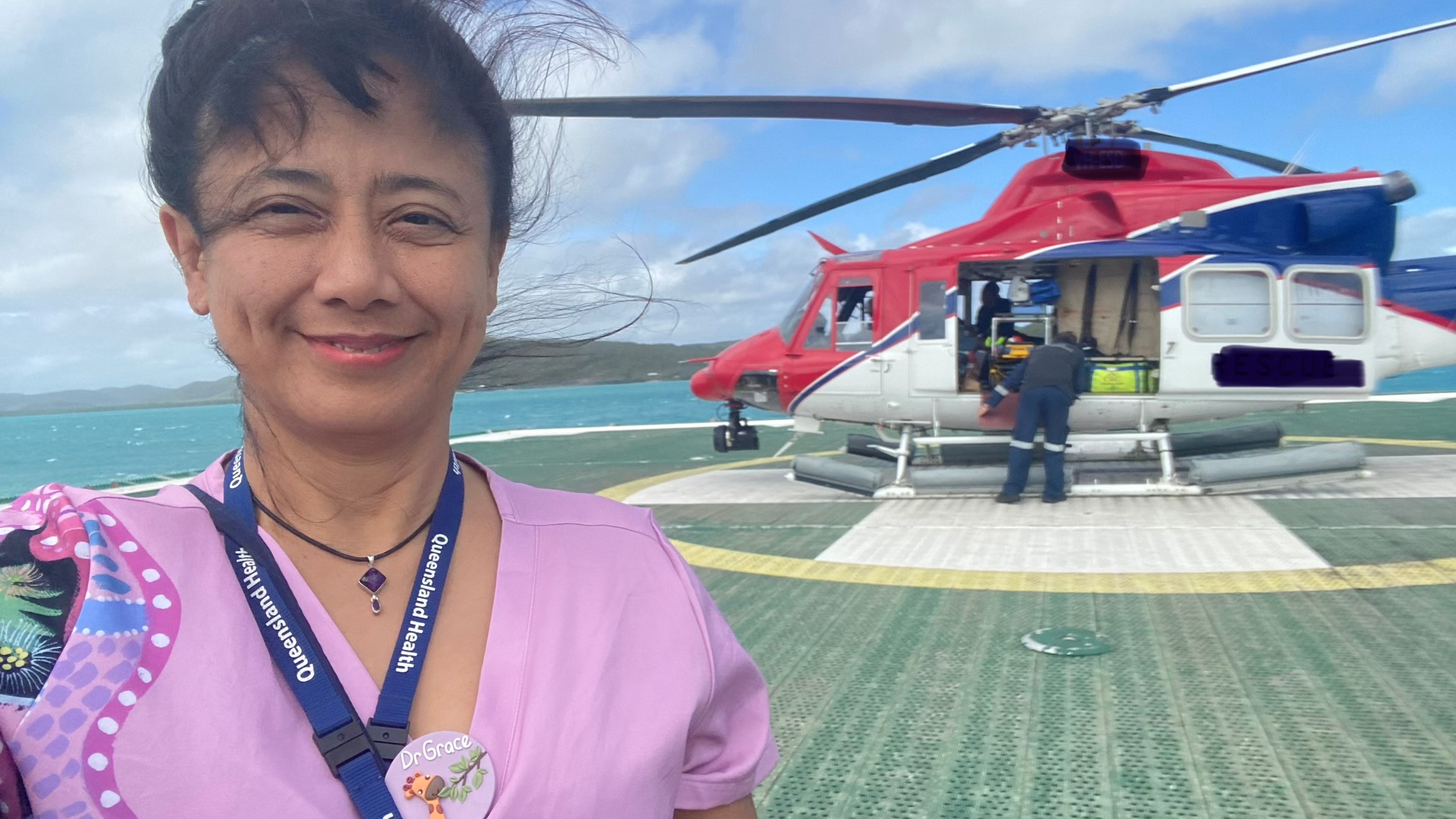
Image: Dr Grace Maano – Rural Generalist Obstetrician
Picture a woman arriving in threatened preterm labour at 24 weeks' gestation, hundreds of kilometres from the nearest tertiary neonatal intensive care unit. Or a woman with severe pre-eclampsia, her blood pressure climbing, knowing she could seize at any moment.
"I'm acutely aware that I'm caring for not just one patient, but two," Maano says. "A mother. And her unborn baby."
She assesses. She stabilises. She gives what treatment is available to her. She speaks with obstetric, neonatal and retrieval colleagues, while her nursing and midwifery team prepares the patient for transfer.
"And then we wait," she says.
When distance becomes part of the diagnosis
Working in rural and remote medicine changes a clinician's relationship with distance. In a metropolitan hospital, the next level of care might be elsewhere in the same building. In remote Australia, it can be hundreds, sometimes thousands, of kilometres away.
"When I have a very premature baby threatening to arrive, I know what that distance means," Maano says. "The neonatal intensive care unit isn't down the corridor."
The same is true for a woman with severe pre-eclampsia, whose specialist obstetric, anaesthetic and intensive care needs may not sit on the other side of a set of theatre doors.
"Our job as Rural Generalists is to provide the best care possible where we are, to recognise deterioration, initiate treatment, stabilise and prepare our patients for what comes next," she says. "But there are moments when the definitive care our patient needs exists somewhere else. That's when Australia's retrieval network becomes part of our team."
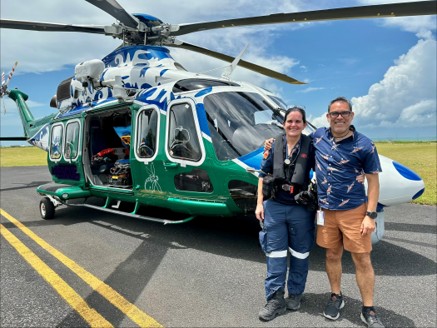
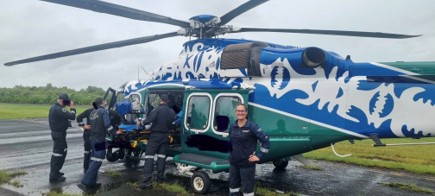
Images above: Dr Lorraine Marshall receiving handover from a relieved Rural Generalist, Dr Dario Rivera and Dr Sally Street - Rural Generalist Obstetrician
The sound that changes everything
The waiting comes with its own particular anxiety. Will her blood pressure stay controlled? Will she seize? Will labour progress? Will the membranes rupture? Will this baby decide to arrive before the retrieval team gets there?
"You keep caring for the patient in front of you while running through contingencies in your head," Maano says. "And then you hear it. The helicopter."
For the patient and her family, its arrival means the next stage of their care has reached them. For Maano, it means something more.
"Help has arrived," she says. "It doesn't mean my responsibility suddenly disappears — there's still a careful clinical handover and transition of care. But the weight changes. The anxiety I've been carrying for that mother and baby is now shared with another highly trained team, equipped to continue their journey towards the specialist care they need. There's something profoundly reassuring about that."
A privilege we should not take for granted.
Maano's work on health projects outside Australia has made her particularly conscious that what she's describing isn't possible everywhere.
"There are rural clinicians around the world caring for women with obstetric emergencies who can't make a phone call and expect an aeromedical retrieval team to come," she says. "The tertiary hospital might be many hours away. The roads might be poor or impassable. An ambulance might not be available. There may simply be no coordinated retrieval system capable of bringing higher-level care closer to that patient."
For those clinicians, and particularly for the women and babies in their care, geography can have devastating consequences. It's a contrast that has left Maano with a deep appreciation for what exists in Australia.
It takes far more than a helicopter
It's easy, watching a retrieval aircraft land, to focus on the aircraft itself. But the helicopter or aeroplane is only the most visible part of a much larger system.
Behind every retrieval are ambulance officers and paramedics, retrieval coordinators, doctors, nurses, midwives, communications teams, receiving specialists, pilots, engineers, operations staff and ground crews. The clinical team has to be ready to manage a critically unwell patient in transit. Pilots make independent safety calls on weather, terrain and aircraft performance. Engineers and ground crews keep the aircraft ready to fly. Coordinators bring all of these moving pieces together, often across enormous distances and under intense time pressure. And at the other end, another team is preparing to receive the patient.
"Retrieval is not simply transportation," Maano says. "It's a chain of people, expertise, communication and trust."
We do not practise alone
Rural Generalists are trained to work with uncertainty, limited resources and professional isolation. "We become resourceful because we have to," Maano says. But she's careful to draw a line between that and the idea of practising alone.
"A woman can become critically unwell in a small hospital in remote Australia, and within hours an extraordinary network of people can mobilise around her and her unborn baby," she says. "That's something worth celebrating."
It's why, she says, the sound of rotor blades approaching a rural hospital will always bring the same familiar relief. It means another team is coming to stand beside hers. It means a mother is being given access to the specialist care she needs. It means a premature baby is being given a better chance of reaching the neonatal care waiting for them.
"We may care for patients hundreds or thousands of kilometres from tertiary care," Maano says, "but we do not practise alone."
To every retrieval doctor, nurse, paramedic, coordinator, pilot, engineer, ground crew member, specialist and rural health professional who makes that possible — thank you.
Sometimes the sound of a helicopter is simply an aircraft arriving. For the clinicians waiting at the other end with a critically unwell patient, it can sound very much like hope.
Dr Grace Maano FACRRM, Rural Generalist | RG Obstetrician
Learn more about Advanced Specialised Training in Obstetrics here.